

The past three months have been bad for Hong Kong stocks, and far worse for tech. Since 4 August the Hang Seng Index has fallen 9%. The Hang Seng Tech Index has fallen 22%, and it is now down 31% this year.
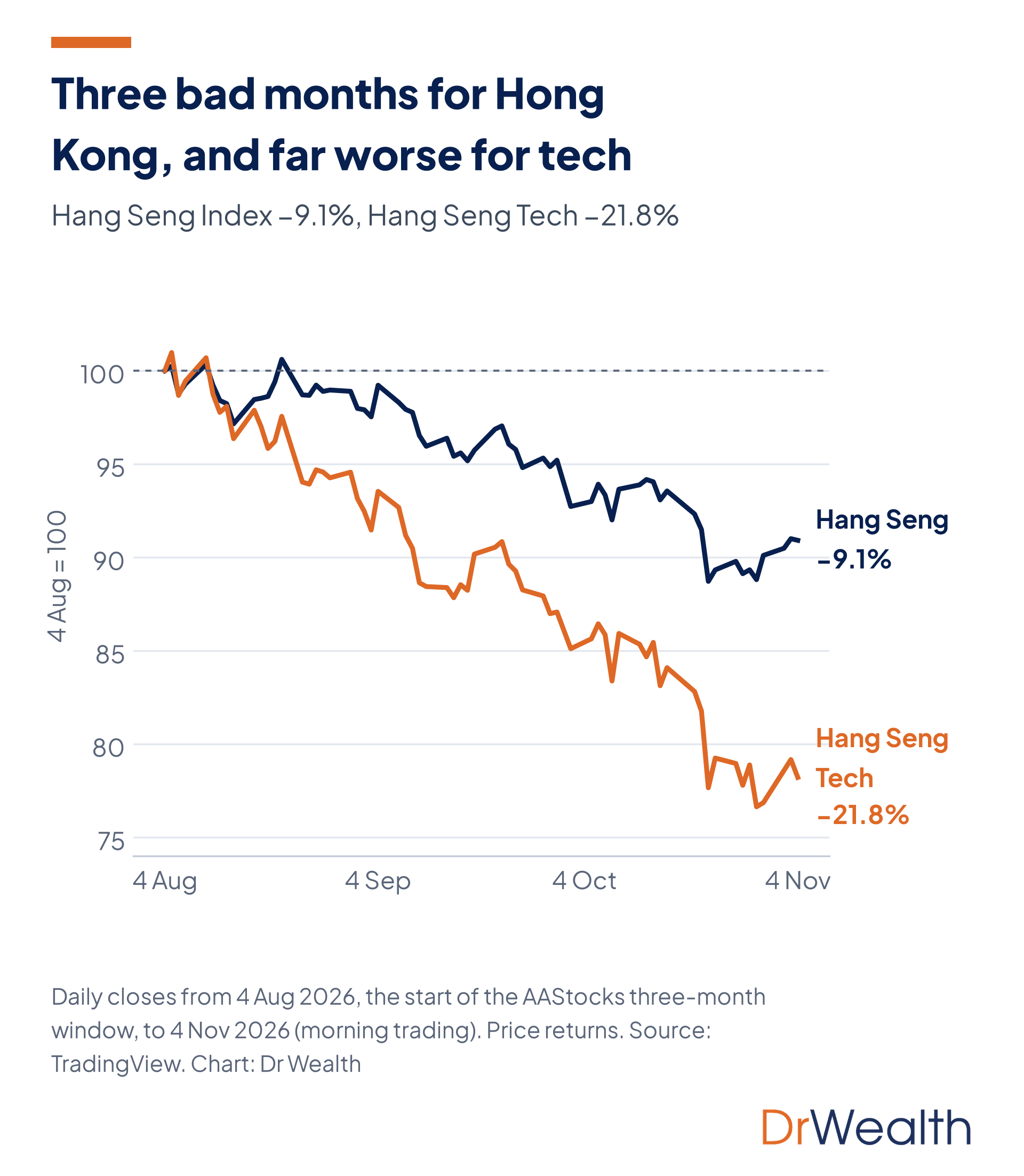
But look beneath the surface of the Hang Seng Index and a different picture appears. While the index fell, 10 of its stocks rose more than 10%. None of them is a tech company.
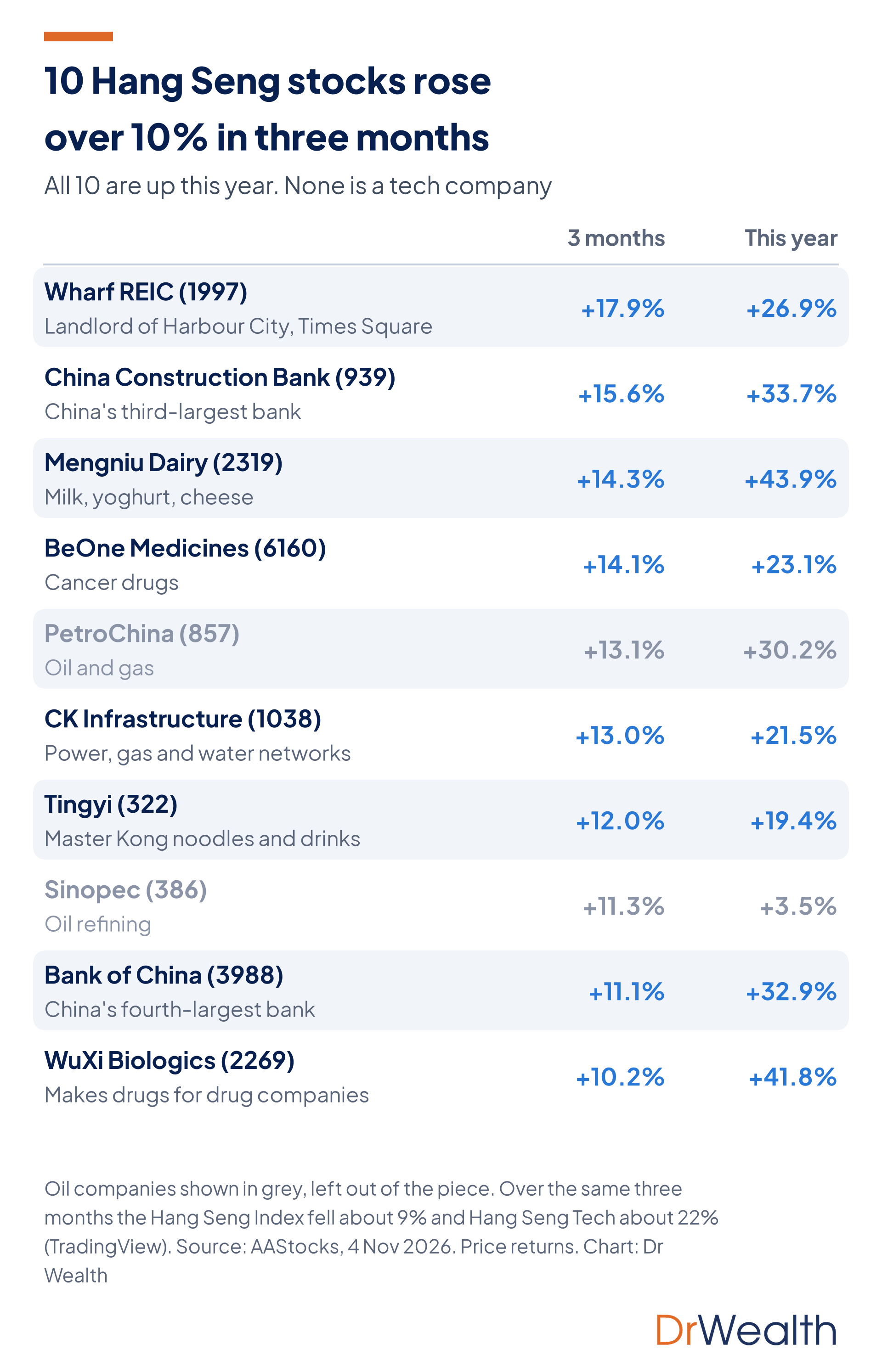
PetroChina and Sinopec are oil companies. And we all know they did well because of the conflict in the Middle East, not because of the tech sell-off or any sector rotation.
That leaves eight. Two banks, a landlord, an infrastructure owner, two drug companies, a dairy and a noodle maker. Is money leaving tech for the dull stuff? And if so, should you follow it?
The US Is Rotating Too
The same picture shows in the US too.
Over the three months to 2 November, health care was the best US sector, up 13.6%. Energy came next, then consumer staples, up 6.8%. In Hong Kong, two of our eight make medicine and two sell food. So in both markets, money moved toward things people buy no matter what the economy does.
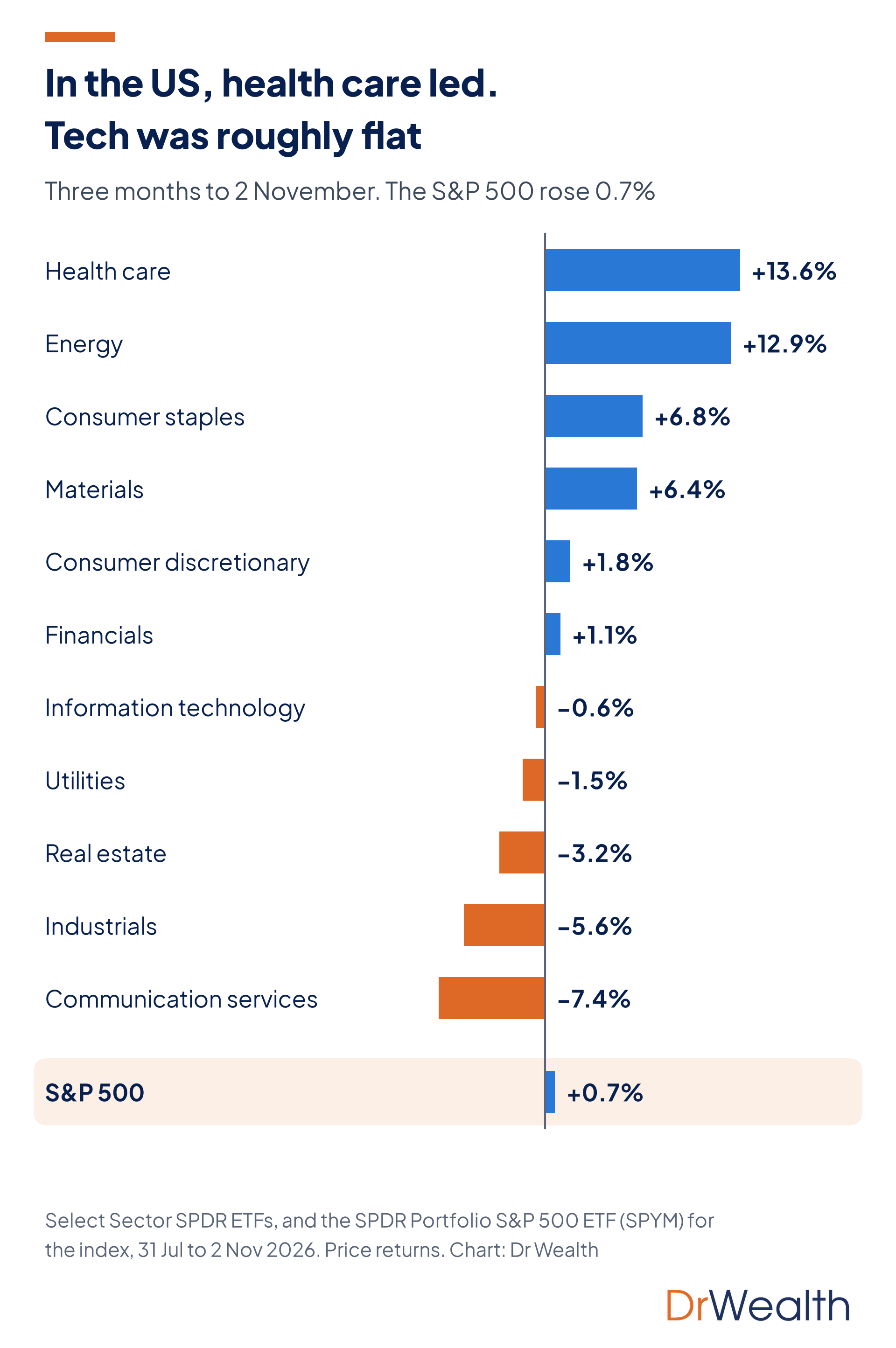
The difference is tech. US tech was roughly flat over the three months, down 0.6%, and the S&P 500 still edged up 0.7%. Hong Kong tech fell 22%. In the US, this is a rotation at the edges. In Hong Kong, it is a stampede.
Look too at what Hong Kong investors bought. Every one of our eight was already up for the year before August began, from Tingyi’s 7% to WuXi’s 29%. Investors didn’t go hunting for bargains. They piled into what was already doing well this year and most of them pay a dividend.
Banks’ Margins Stabilized And Profits Grew
China Construction Bank (939) is China’s third-largest bank by assets, behind ICBC and Agricultural Bank of China. Bank of China (3988) is fourth. Both are up about a third this year and are at their highest in years.
There is real news behind it. For years, lower interest rates squeezed China’s big banks. The last cut to the benchmark lending rate came in May 2025, and it hasn’t moved since. Banks cut what they pay savers at the same time, taking one-year deposit rates below 1% for the first time. Loan rates fell quickly. Deposit costs fall slowly, because a fixed deposit only resets when it matures. This year the cheaper deposits have been catching up, and the squeeze has stopped.
The numbers show it. The big four’s net interest margin, roughly what they earn on loans minus what they pay on deposits, held steady or edged up in the first nine months of 2026. In the third quarter, ICBC, Agricultural Bank and CCB each grew profit by about 10%, their fastest in four or five years. Bank of China grew 6.4%.
So why did CCB rise the most? The clearest reason is its margin. It earns the widest of the four, 1.36% against 1.27% to 1.29% for the others, and its margin widened the most this year. Its net interest income grew 10% in the first nine months.
But the price has run ahead of the profit. CCB’s profit rose 6.6% in the first nine months, while its share price is up 33% this year. Most of the gain is investors paying more for the same earnings. That shrinks the yield, now about 4.3% for both banks. As H shares, they lose 10% to withholding tax for a foreign investor, which leaves about 3.9%.
Selling Assets And Raising Cash
Wharf REIC (1997) owns Harbour City in Tsim Sha Tsui and Times Square in Causeway Bay. Since listing in 2017 it has been paying down debt, from over HK$42 billion then to HK$29.2 billion in June. In July it agreed to sell Wheelock Place in Singapore for S$1.1 billion, 12% above its book value, which should take debt to about HK$20 billion by the end of the year. It is also selling Scotts Square, its last Singapore building, for a reported S$310 million.
So what is it doing with the money? No special dividend, and no buyback. With debt this low, the board instead raised the share of its regular profit it pays out, from 65% to 90%, from this year on. The interim dividend rose 42% to HK$0.94. The company says the change means about 38% more in dividends. On last year’s HK$1.32, that would be about HK$1.82 a share, a yield of about 5.8% at today’s price. The stock jumped 14% the day it announced this and 21% over two days. That was its whole three-month gain, and it has drifted slightly lower since.
CK Infrastructure (1038) is the Li Ka-shing family’s utilities arm, with power, gas and water networks in the UK, Australia, Europe, Canada and New Zealand. This year it sold its stakes in UK Power Networks and its UK train leasing business. Its share of the UK Power Networks price alone was HK$44.6 billion. That lifted first half profit to HK$21.3 billion, from HK$4.4 billion a year earlier, and almost all of it is one-off.
So what is CKI doing with the money? Not a special dividend, and not a buyback either. The interim dividend rose just 2.7%, to HK$0.75. Management says its HK$33.9 billion of net cash, about a fifth of the company’s market value, is for acquisitions, “large scale capital intensive projects”, possibly alongside sister companies CK Asset and Power Assets. Nothing has been announced yet.
The Drug Companies Raised Growth Targets
These two are growing faster than anything else on the list, and in August both told investors this year would be better than they had said. We think that is the main reason they rose.
BeOne Medicines (6160) used to be called BeiGene. Its blood cancer drug Brukinsa now sells more than US$1 billion a quarter. On 5 August it reported second quarter revenue up 30% to US$1.7 billion, and a profit of US$237 million. It also raised its full year revenue forecast to US$6.6 billion to US$6.8 billion, from US$6.3 billion to US$6.5 billion. Third quarter results are due on 5 November.
WuXi Biologics (2269) develops and makes biotech drugs for other drug companies. Its first half revenue rose 18% and its order book reached US$25.1 billion. It raised its 2026 sales growth forecast to 15% to 18%, from 13% to 17%. Take out the effect of the stronger yuan and that is 20% to 23%. Customers keep signing, too. On 2 November, Germany’s Fresenius handed it up to 37 copycat biotech drugs to develop over 10 years.
So why did WuXi give back 18% in October? The likeliest reason is Washington. Under the BIOSECURE Act, passed last December, the US government must publish a list of “biotechnology companies of concern” by around 18 December. Companies on it will eventually be cut off from work for US government contractors. WuXi Biologics isn’t named in the law, but some US law firms say it could make the list. Its sister company WuXi AppTec is already on a separate Pentagon list, which a court has put on hold.
The Consumer Stocks That Grew Sales
Mengniu (2319) is China’s second-largest dairy. First half sales rose 7.8% and profit 16%, and management raised its full year sales target to high single digits. The shares are up 44% this year, at their highest in almost three years. At this price Mengniu yields just 2.9%.
Tingyi (322) makes Master Kong instant noodles and iced tea. First half profit rose 7.1%, but sales rose only 1.1%. The growth came from fatter margins, not more noodles. It yields 3.6%, well below the roughly 6% it has paid on average in recent years.
So most of the eight had a reason. The banks’ squeeze has stopped. BeOne and WuXi are growing fast. Wharf REIC is paying out more now its debt is down, and CKI is sitting on a pile of cash. But in almost every case the price rose faster than the profit, because investors wanted something safe that pays. Here is what they pay at today’s prices.
