

What happened in China this week:
China’s Economy Is Splitting in Two
China’s Banks Just Had Their Best Results Together Since 2022
Meituan Is Profitable Again
Chinese Are Gobbling Up Domino’s Pizzas
Zhipu AI Revenue Blasts Through 400%
#1 China’s Economy Is Splitting in Two
China’s August data reads like it was written by two different economies.
On one page, things are turning a corner. The private-sector services PMI rose to 51.4 from 50.4. New business accelerated, employment grew for a fourth straight month, and the composite PMI, which blends manufacturing and services, climbed to 52.1. Manufacturing improved too. The official PMI rose to 49.8 from 49.2, and new orders jumped from 48.5 to 50.6. A PMI reading above 50 signals growth, below 50 means contraction, so this is real, broad-based improvement in sentiment.
On the other page, the numbers are far uglier. Second-quarter GDP growth slowed to 4.3%. Retail sales grew just 0.6% in July. Fixed-asset investment, spending on everything from factories to property, fell 6.7% in the first seven months of the year. Property investment plunged 19.2%.
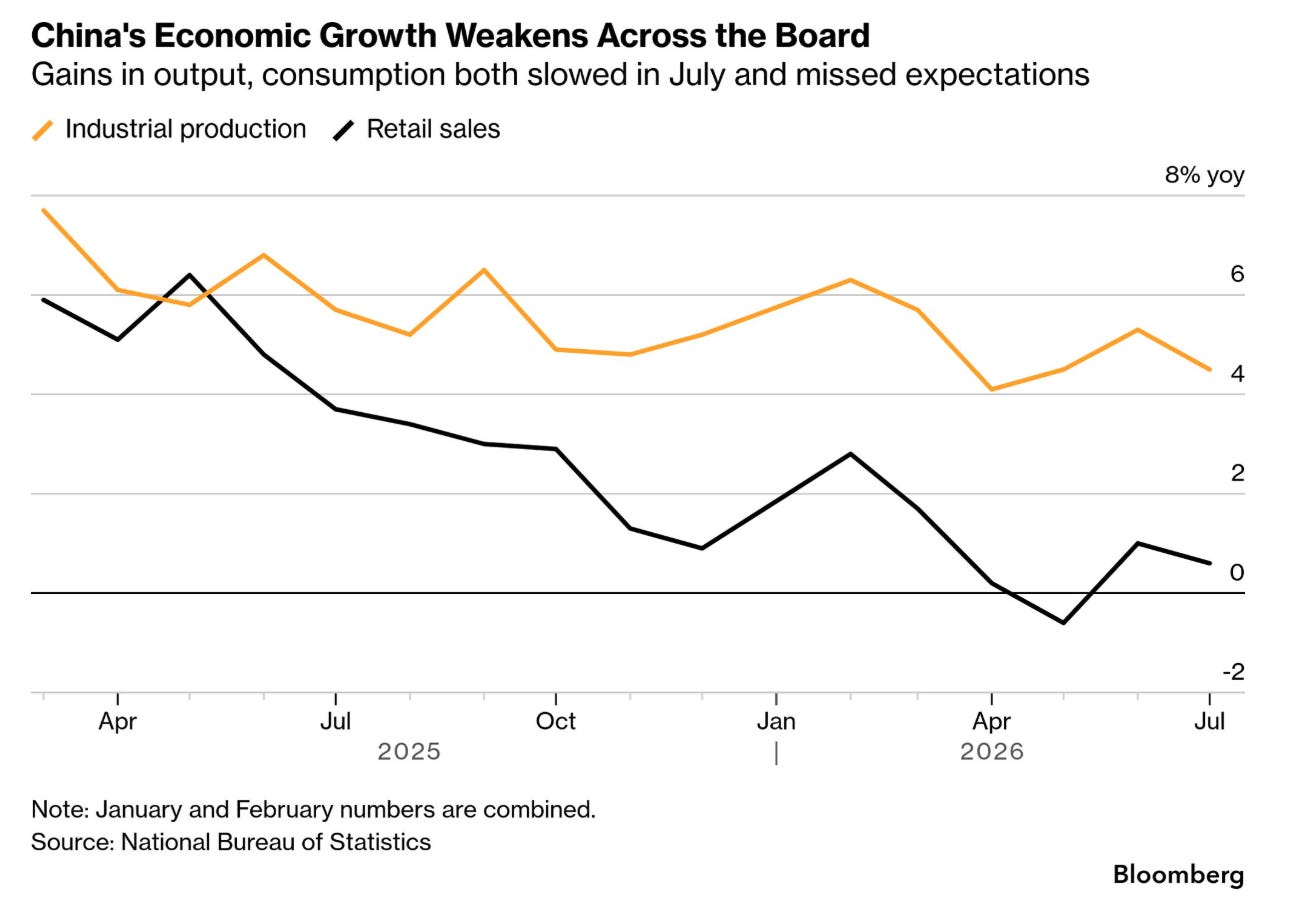
Same country, same month, two completely different stories.
The distinction that actually matters isn’t good news versus bad news. It’s the parts of China riding a structural investment wave against the parts still stuck with the old property-and-consumption model.
High-tech manufacturing sits firmly in the first camp. Electronic machinery and computer-related sectors posted production and new-order readings above 53. Integrated-circuit and industrial-robot output kept growing strongly. Exports have held up too, helped by global demand for Chinese technology and AI-related infrastructure. This is why China can post strong manufacturing numbers in selected industries while households and traditional businesses stay under pressure.
This matters for positioning because policy is likely to decide which parts of the economy end up outperforming. Growth at 4.3% sits below Beijing’s 4.5% to 5% target range, and that alone should be enough to trigger a response. Expect more fiscal spending, faster local-government project approvals and targeted lending support in the months ahead.
Weak headline growth does not automatically mean weak equity returns. If anything, the widening gap between the real economy and China’s strategic industries is where the opportunity lives. Beijing is directing capital toward technology and industrial upgrading, and global demand is adding fuel on top. That’s how companies tied to semiconductors, AI infrastructure, robotics and advanced manufacturing keep growing even while the broader economy limps along.
The investment case is shifting. It’s no longer “China’s economy will recover.” It’s “China is reallocating capital toward the industries it considers strategically important.”
